Permits
Do You Need a Permit for a Dumpster in Pontiac?
On your own driveway, almost never. The harder question here is which of seventeen cities, villages and townships you are actually standing in.
The short answer
If the container is going on your own driveway or your own property, you almost certainly do not need a placement permit. That covers the large majority of what we deliver.
If it has to sit on a public street, you will need permission — and which office grants it depends entirely on which jurisdiction the address is in, which around here is a genuinely non-trivial question.
Private property: no permit
A driveway, a side yard, a private parking area, a fenced construction site, a commercial lot you own or lease — all private property, and no municipal placement permit for the container itself.
Two caveats that are not placement permits but behave like them. The underlying work may need a building permit — structural, electrical, plumbing, roofing and anything touching the building envelope generally do. And if the property is a rental or has an association, their permission is not optional.
Public street: right-of-way permission
Placing a container in the street means occupying public right-of-way, and every jurisdiction here regulates it. The instrument varies — an encroachment permit, a right-of-way permit, sometimes simply written permission — but the principle does not. It exists for emergency access, sight lines, drainage and night-time visibility.
Our advice is always to get it onto private property where possible. In the newer subdivisions of Rochester Hills, Troy and Auburn Hills that is easy. In central Pontiac, Birmingham, Keego Harbor, Sylvan Lake and the Lake Orion village it is sometimes genuinely not.
Useful numbers for judging your own frontage: a 20 yard is twenty-two feet of container and the truck needs roughly ten more feet of clear run behind it. A 15 yard takes six feet less on the ground.
Worth noting separately that county roads are the Road Commission's, not a city's — so on a county road the question goes somewhere different again.
⚠️ Seventeen jurisdictions, seventeen answers
This is the thing that actually catches people in Oakland County.
Our regular service area covers seventeen separate cities, villages and townships, and each one sets its own rules. There is no county-wide answer to give you.
So "what does Oakland County allow?" is not a question with an answer. "What does Waterford Township allow?" is. Search results do not respect municipal boundaries, and a page about Pontiac's arrangements is not about Birmingham's.
One convenience: Pontiac is the county seat. Oakland County government sits at 1200 N Telegraph Road, inside the city, so for genuinely county-level questions the office is local.
Village or township is a real question
A specific version of the above that trips people up repeatedly here.
Several of the places we serve are a small village surrounded by a much larger township of the same or a similar name, and they are separate jurisdictions:
- Lake Orion village sits inside Orion Township
- Clarkston village is very small; Independence Township surrounds it
- Holly village sits within its township
- Oxford village sits within its township
The boundary is not obvious from an address, the postal town is the same either way, and the rules differ. When it matters, check rather than assume — and if you are not sure, tell us and we will work through it with you.
The other permits people actually need
The container is rarely the regulated thing. These are:
- Building permits for the underlying work.
- Demolition permits, usually separate, and often carrying their own debris conditions.
- ⚠️ Asbestos notification. The one that genuinely matters on older buildings here. Asbestos demolition and disposal fall under the federal NESHAP, administered in Michigan by EGLE's Air Quality Division. Notification obligations attach to demolition and renovation work, and they are not optional.
- Tree removal rules in some jurisdictions — relevant across the wooded lots of Bloomfield Hills and West Bloomfield.
- Open burning restrictions, which vary locally and are tighter than people assume.
If the work is under a demolition permit in an older building, get the asbestos question settled before the permit rather than after. More on what is actually in these houses here.
Tree canopy and the twenty-two foot problem
A practical constraint rather than a legal one, but it stops more deliveries here than permits do.
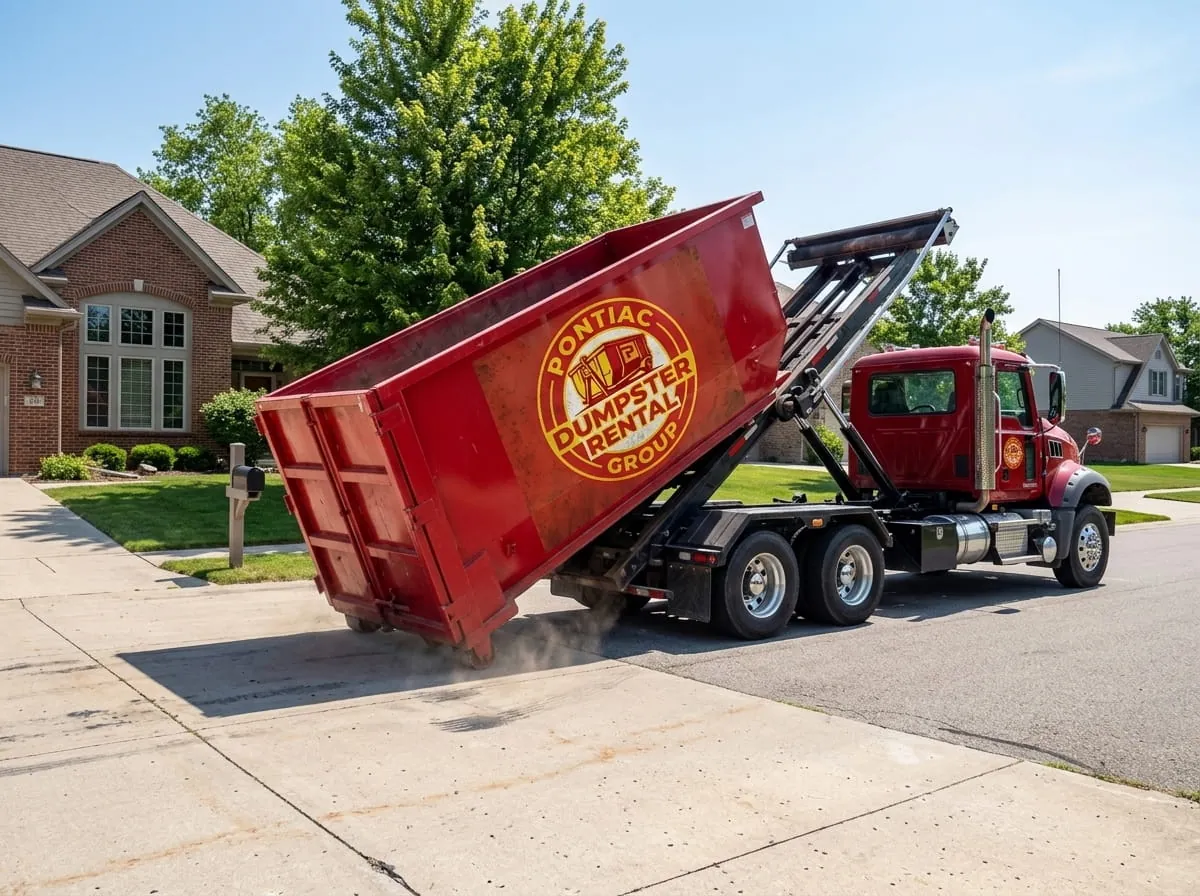
Our truck needs roughly twenty-two feet of clear height to raise its bed and set a container down. Oakland County has a great deal of mature tree canopy, and in several parts of our area it is directly over the place you want the container.
- Bloomfield Hills and West Bloomfield — long curved drives under heavy canopy. Width is rarely the problem; height is.
- Birmingham and older Rochester — mature street trees over short driveways.
- The lakes district — wooded lots plus long shared drives plus soft ground near water.
- Rural Holly, Oxford and Clarkston township — long unpaved drives, plus overhead power and phone lines crossing at the entrance.
Tell us at booking and we will plan a placement that works. It is much easier than turning a loaded truck around.
One seasonal note while we are on scheduling: Michigan roads carry seasonal weight restrictions during spring thaw, which can affect what a loaded truck may run on and when. It rarely stops a job, but it occasionally shifts a date, and it is better mentioned than discovered.
What we need from you
- Whether the container is going on private property or the street
- Which city, village or township the address is in — and if it is a village-inside-a-township, which of the two
- Whether there is a landlord or association, and whether you have asked them
- Your driveway length, width, surface and grade
- Any branches, wires or low overhang near the placement
- Whether the underlying work is permitted
- Roughly when the building was built, and whether asbestos testing has been done
If street placement turns out to be necessary, we will tell you which office to approach. We cannot pull the permission for you — it attaches to the property owner or contractor — but we work across all of these jurisdictions and can make sure you ask the right one first time.
Regulations change and vary by jurisdiction. Everything above reflects how these authorities operate at the time of writing. For anything consequential, confirm with your own city, village or township office.
Need a container in Pontiac?
Call and describe the job. Three minutes on the phone gets you a size recommendation, a flat rate and a delivery window — and we will tell you if a smaller, cheaper container is the right answer.
Call (947) 500-4675