
Sizing
What Size Dumpster Do I Need? An Honest Local Guide
Most guides ask you to estimate in cubic yards. Around here the more useful question is what decade the house was built in.
Start with the material, not the number
Very few people can estimate their own debris in cubic yards, and guides that ask you to are not much use. What we actually ask is three things: what are you throwing out, roughly how much in terms you can picture, and where will the container sit.
Those three answers pick the size reliably. The cubic yard figure is just the label on the box.
Volume and weight, and which binds first
Every container has two limits and you will hit one first. Volume is obvious — you cannot load above the top rail. Weight is the one people forget and the one that costs money.
Each size includes a tonnage allowance: roughly one to two tons on a 10 yard, four to five on a 30. Past that you pay a per-ton overage, which we quote before you book.
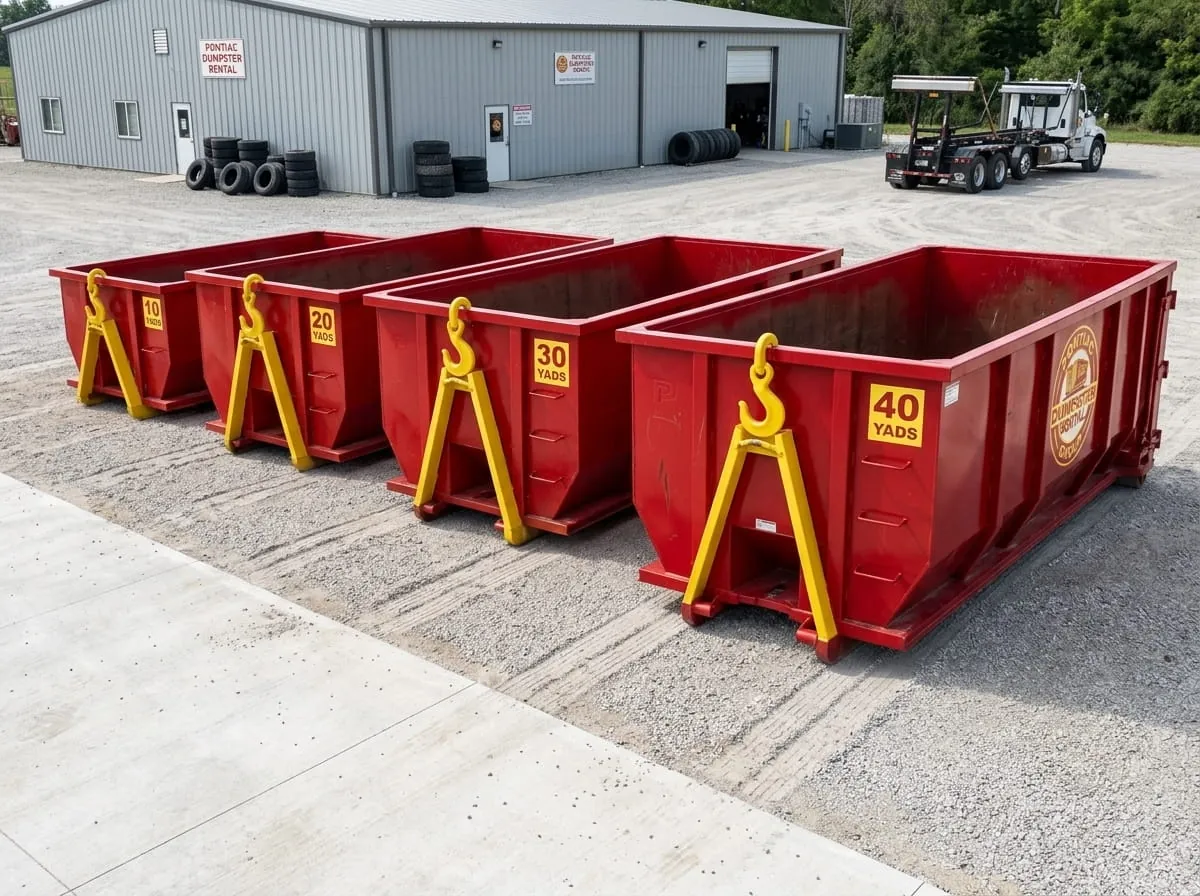
What each size really holds
10 yard — 12 ft × 8 ft × 3.5 ft
Three to four pickup loads, one to two tons. The small-job container and, more importantly here, the heavy material container: concrete, block, plaster, tile and soil. Low sides mean you can throw material over the wall without a ramp.
15 yard — 16 ft × 8 ft × 4 ft
Five to six pickup loads, two to three tons. The under-used size, and the one we place most often in the older close-set streets of Pontiac, Birmingham, Rochester, Keego Harbor and the Lake Orion village, where sixteen feet fits a short driveway and twenty-two does not.
20 yard — 22 ft × 8 ft × 4.5 ft
Seven to eight pickup loads, three to four tons. Our most common residential container, and the default across the newer subdivisions in Rochester Hills, Troy and Auburn Hills where driveways are generous.
30 yard — 22 ft × 8 ft × 6 ft
Ten to twelve pickup loads, four to five tons. Same footprint as the 20 with eighteen more inches of height, so it holds half again as much without needing more driveway. The right call for a whole-house clear-out with a basement, or a job site.
Worked examples from local jobs
| Job | Size | Why |
|---|---|---|
| Bathroom, newer house | 10 yard | Small volume; tile and fixtures are dense |
| Bathroom, pre-war house | 10 yard | Plaster and cast iron — watch the weight |
| Patio or driveway slab removal | 10 yard | Concrete runs ~2 tons per cubic yard |
| Kitchen, newer house | 15-20 yard | Cabinetry eats volume |
| Kitchen, older house | 15 yard | Plaster weight caps it sooner |
| Older close-set street, any job | 15 yard | Access is the limit, not volume |
| Composition re-roof, 24 squares | 20 yard | Around 4 tons — at the allowance |
| Basement clear-out | 20 yard | Bulky and light — volume binds first |
| Basement finish-out demo | 15 yard | Panelling, framing, often concrete |
| Full garage and shed clear-out | 20 yard | Bulky and light |
| Whole-house clear-out with basement | 30 yard | Contents fill volume before weight |
| Mature tree removal | 20-30 yard | Cut it down first; it halves the volume |
| Whole-house plaster gut | Multiple 10s or 15s | Never one large container |
House age is the local variable
The thing that changes the answer most around here, and the thing least likely to be in a national sizing guide.
Pre-war housing has plaster over wood lath instead of drywall, real dimensional lumber, hardwood floors and cast iron plumbing and radiators. Strip a room in a 1925 house and a 1985 house and the older one produces roughly double the weight for the same volume of space.
Practically: if the house predates about 1960, drop a size and add a swap. A 10 yard collected twice costs less than a 20 yard that cannot be lifted, and it is far more likely to actually leave your driveway on the day you want it to.
The full picture on older-home debris is here, including what to test for before demolition starts.
Basements change the answer
Almost every house in this county has a full basement, and on a clear-out the basement routinely produces more volume than any other floor.
Two effects on sizing:
- Clear-outs size UP. Basement contents are bulky and light — furniture, boxes, storage, old panelling. Volume binds long before weight, so a whole-house clear-out with a basement is a 30 yard.
- Basement demolition sizes DOWN. Framing, panelling, dropped ceilings and frequently a concrete or block element. Weight binds first.
A job that involves both usually wants two containers rather than one compromise — and the labor saving from placing the container close to the basement door is larger than the difference in rental cost.
Where placement decides the size
In some parts of our area the site picks the container, not the job.
- Keego Harbor and Sylvan Lake — small lots, narrow streets, houses close together. Often a 10 or 15 yard is simply what fits.
- Birmingham and the Lake Orion village — short driveways and mature street trees. A 15 yard places where a 20 will not.
- Bloomfield Hills and West Bloomfield — space is not the issue; overhead clearance is. We need roughly twenty-two feet of clear height to raise the bed, and a long curved drive under mature trees is the most common reason a delivery needs replanning.
- Lakefront property anywhere — shared drives, steep approaches and soft ground near the water.
- Rochester Hills, Troy, Auburn Hills — wide driveways, straightforward, size for the job.
How to describe your job on the phone
- Roughly when the house was built. The single most useful sentence.
- Plaster or drywall. Tap a wall — plaster is solid and dull.
- Whether the basement is in scope.
- Whether there is concrete, block or soil. Those get their own small container.
- Driveway length, width, surface — and any overhead branches.
- Which city or township, because arrangements differ across all seventeen we serve.
Ninety seconds on the phone is the difference between a flat rate that holds and a truck that has to leave again.
Need a container in Pontiac?
Call and describe the job. Three minutes on the phone gets you a size recommendation, a flat rate and a delivery window — and we will tell you if a smaller, cheaper container is the right answer.
Call (947) 500-4675